How I Built My Marketing Lab Site as a .NET Developer (And What I Learned)
I have spent my career as a full-stack .NET developer. Web applications, APIs, databases, system architecture — that is my world. So when I decided to add digital marketing as a second skill set, most people asked me the same question: why?
The honest answer is that marketing is just another form of problem solving. It has data, it has systems, it has cause and effect — and when something is not working, you have to debug it. That framing made the whole thing click for me.
But there is another reason too. I love data, I love content, and I love the challenge of communicating value. Those three things sit right at the heart of good marketing. The more I looked at it, the more I realised that a developer who understands marketing is genuinely rare — and genuinely useful.
So I built a lab site to learn on. This is what I focused on, what I learned, and why I think my technical background gave me a different perspective from day one.
Why a lab site first
You cannot learn marketing by reading about it. You need something live, something real, something Google can actually crawl. A lab site gives you that — a place to run experiments, make mistakes, and see what actually happens when you publish something and wait.
I set up alexbuildsonline.com for exactly this purpose. It serves two goals at once: it is where I learn and document my marketing journey, and it is the home of my freelance services. Every experiment I run on my own site is directly applicable to the work I do for clients.
Choosing the right foundation
As a developer I had strong opinions about the technical setup. Performance was my first priority — not because I was being precious about it, but because site speed is a genuine ranking signal for Google. I wanted a foundation that would score well on Core Web Vitals without constant maintenance overhead.
I also wanted the deployment pipeline to be seamless. Publishing a blog post or updating a page should take seconds, not a production deployment ceremony. Getting that right from the start means I can focus on content and marketing rather than infrastructure.
The result is a setup I am genuinely happy with. It is fast, reliable, and gets out of my way.
What I prioritised on day one
Before writing a single word of content, I made sure the site was properly instrumented. This is where my developer instincts kicked in — you do not ship without monitoring.
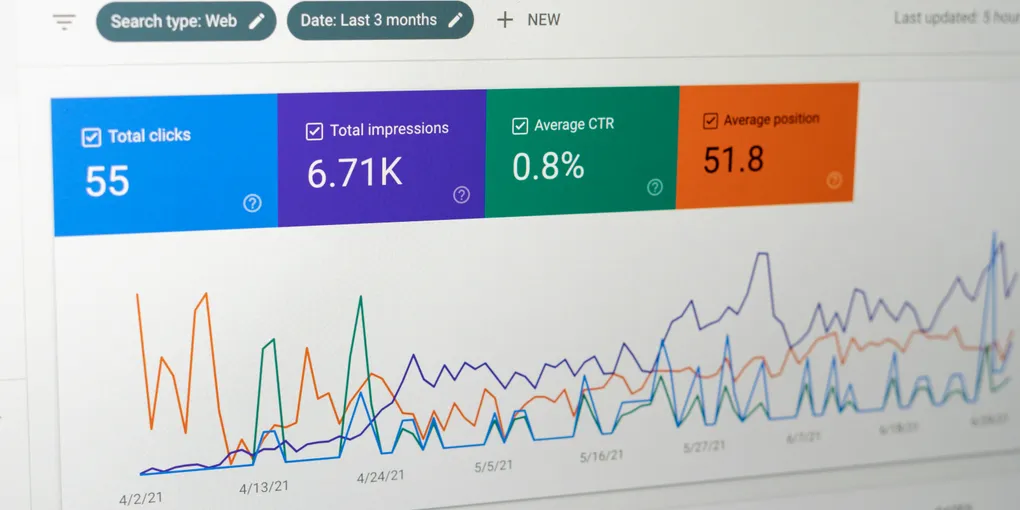
I connected the site to Google’s core webmaster tools so I could see exactly how it was performing in search from day one. I set up web analytics to track visitor behaviour. And I ran a technical audit to make sure there were no underlying issues that would hold the site back before it even got started.
The audit came back clean. No broken links, no missing metadata, no indexing problems. That is not luck — it is what happens when a developer builds a site with these things in mind from the start rather than bolting them on afterwards.
What surprised me about marketing
The thing that genuinely surprised me was how much of marketing comes down to measurement — and how badly most businesses measure.
The data is almost always there. The problem is the setup. Businesses are making decisions based on numbers that look correct on the surface but are fundamentally unreliable underneath. Duplicate tracking, internal traffic polluting the data, conversions being counted that should not be — these are technical problems that require technical solutions.
Most marketers do not have the background to spot them. Most developers do not care enough about marketing to look. I sit in the middle — and that turns out to be a very useful place to be.
What this means for clients
If you are a business owner looking at your analytics dashboard and something feels off — your numbers do not match reality, your conversions seem too high or too low, your traffic looks unusual — there is a good chance your setup has problems you have never noticed.
That is exactly what my Technical Marketing Audit covers. I go through your analytics configuration, your search data, your technical SEO health, your site performance, and your on-page optimisation — and I deliver a prioritised report of what to fix and how.
It costs $500 and takes five business days. If I do not find at least five genuinely actionable improvements, I refund you in full.
If that sounds useful, get in touch.
I am documenting my journey from developer to digital marketer on this blog. If you want to follow along, subscribe below — I write about technical SEO, analytics, and what I am building.